Rental income and loss limits
CRA says CCA cannot create or increase a rental loss. Calculate the overall rental-income position before assuming a deduction is available.
Canadian rental property tax planning
Capital cost allowance can reduce current taxable rental income, but the decision should also consider loss restrictions, future recapture, sale timing and the owner's wider tax position.
Written by Calvin Zhou. Reviewed September 26, 2026. General educational information only—not tax or legal advice.
What CCA does
CRA describes CCA as the deduction available over several years for depreciable rental property such as a building, furniture or equipment. Land is not depreciable, and the applicable class and available-for-use rules matter.
The owner can claim less than the maximum available amount, including zero. The decision is therefore partly about timing: reducing taxable rental income now may change the amount exposed to recapture later.
| Today | Rental income before CCA |
| Current claim | Available CCA and tax effect |
| Holding period | Cash retained and reinvested |
| Sale | Possible recapture and gain |
| Net result | Timing and after-tax proceeds |
Decision factors
CRA says CCA cannot create or increase a rental loss. Calculate the overall rental-income position before assuming a deduction is available.
A long holding period can make tax deferral more valuable, while a near-term sale may bring the recapture question forward.
The value of timing depends on the owner's circumstances, other income, entity structure and future plans—not only the property's standalone result.
The building and qualifying equipment may be depreciable; land is not. Purchase-price allocations should be supportable and professionally reviewed.
Mixed personal and rental use or change-in-use facts can introduce additional rules. Do not claim CCA without understanding how it interacts with the intended treatment.
CCA affects taxable income, not mortgage principal, repairs or replacement reserves. The property still needs enough cash to carry its obligations.
What happens on sale
CRA explains that recapture can arise when disposition proceeds allocated to depreciable property exceed the class's undepreciated capital cost, subject to the applicable rules. A separate capital gain may arise when a property is sold for more than its adjusted cost base and selling costs.
The sale model should therefore include the building and land allocation, undepreciated capital cost, estimated sale proceeds, selling costs, recapture, capital gain and debt repayment.
HS can compare the property cash flow and exit scenarios using tax inputs supplied or confirmed by the owner's accountant. The objective is to make the timing and decision consequences visible.
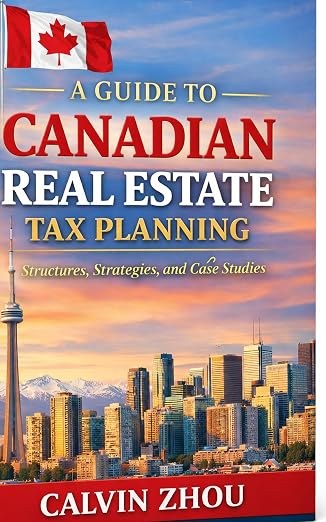
Further reading by Calvin Zhou
Explore the wider relationship between deductions, ownership, financing, cash flow and exit strategy through practical real estate tax-planning discussions. Kindle edition: CAD $39.99.
The book provides general educational analysis. Current rules and property-specific implementation should be confirmed with qualified tax and legal professionals.