What kind of rental activity is this?
CRA distinguishes income from property from income earned through a business by considering the nature and extent of services provided. The facts influence how the activity is reported and taxed.
Canadian real estate ownership structure
A corporation can change tax treatment, financing, administration, legal ownership, cash extraction and exit flexibility. It does not automatically produce a better result.
Written by Calvin Zhou. Reviewed September 26, 2026. General educational information only—not tax or legal advice.
Five questions
CRA distinguishes income from property from income earned through a business by considering the nature and extent of services provided. The facts influence how the activity is reported and taxed.
Personal savings, retained corporate cash, shareholder loans and new investors create different cash movements and documentation requirements.
Compare rate, amortization, guarantees, recourse, lender fees, covenants and required equity. A tax idea can be overwhelmed by weaker financing terms.
Cash retained in a corporation is not the same as cash available personally. Model compensation, distributions and reinvestment with the tax advisor.
Sale of the property, sale of shares, transfer to family, refinancing and reinvestment can produce different legal, tax and commercial outcomes.
A transfer is not merely an internal bookkeeping entry. Obtain tax, legal, lender, title and valuation advice before changing ownership.
Corporate rental income
CRA's current T2 guide explains that a business whose principal purpose is earning income from property—including rents—can be a specified investment business. Such income is generally not treated as active business income eligible for the small business deduction unless a statutory exception applies.
This classification is fact-dependent. The services provided, employees, associated corporations and the actual operation must be reviewed by the corporation's tax advisor.
Read the CRA T2 guide on specified investment businesses and CRA's rental income or business income guidance.
| Acquisition | Equity, closing and transfer costs |
| Operations | Tax, cash and administration |
| Financing | Terms, guarantees and covenants |
| Owner cash | Retention and withdrawal |
| Exit | Sale, transfer or refinancing |
Transferring an existing property
CRA guidance notes that deferral of capital gain or CCA recapture may be possible when rental property is transferred to a corporation or partnership. That does not mean every transfer is tax-free or advisable. Elections, consideration, debt assumed, legal ownership, land-transfer costs and lender consent can all matter.
Review CRA's transfer and replacement-property guidance, then obtain transaction-specific advice.
Build the side-by-side financial model: acquisition funding, financing, operating cash flow, estimated tax inputs, owner cash and exit sensitivities. The accountant and lawyer confirm and implement the structure.
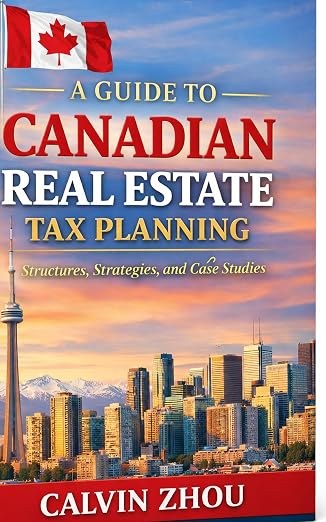
Further reading by Calvin Zhou
The book explores structures, strategies and case-style decisions where ownership, financing, cash flow and tax planning must be considered together. Kindle edition: CAD $39.99.
Use the book to identify questions and alternatives—not as a substitute for current property-specific tax or legal advice.